
Products For Flawless Make-up
Achieving a flawless makeup look is all about having the right tools and products at your fingertips. Whether you're preparing for a special occasion or simply enhancing your everyday beauty routine, the perfect combination of cosmetics can make all the difference. From velvety primers that create a smooth canvas to luminous foundations that provide seamless coverage, each product plays a crucial role in elevating your makeup game. Explore our selection of expertly curated essentials designed to help you achieve that coveted airbrushed finish with ease and confidence.


Products For Flawless Makeup
Products for flawless make-up help create an even-looking base without covering every freckle or taking the sheen off the whole face. The difference between a base that looks like skin and one that looks like a layer of make-up often comes down to where the coverage sits. A sheer foundation lets freckles show through and softens variations in tone, while a medium-coverage formula gives a more uniform finish without necessarily looking heavier. Full coverage need not mean covering the whole face: a little concealer beside the nostrils or at the inner corners of the eyes can even out those areas while leaving the rest of the base quite light. A smoothing primer can help foundation glide over areas of uneven texture, while a mattifying primer suits parts of the face where shine tends to show, such as the forehead and nose. A fluid foundation that spreads easily can give a fine veil of colour, whereas a cream base offers more control where coverage needs to be concentrated. Pressed powder foundation is another option for those who prefer a soft matte effect without wearing separate layers of liquid foundation and setting powder. Shade matters just as much as texture. A swatch along the jawline shows how a foundation sits against both face and neck, which is harder to judge from a swatch on the back of the hand. At the same depth, one shade might lean golden, another rosy and another more neutral. The names on the packaging are only a starting point: a beige that appears muted in the bottle may look distinctly peachy against the skin. Where the face and neck differ in colour, a shade that softens the contrast often looks more convincing than one matched to the centre of the face. The same approach applies to concealer. For coverage around the nose or chin, a shade close to the foundation is less visible at the edges than a noticeably lighter one.
Finish is separate from coverage: a sheer tint can look matte, and a foundation with more coverage can still have a soft sheen. Where make-up tends to catch on dry patches, a supple satin base with less powder can look more even than a flat matte finish. On combination skin, a finely milled powder can take the gloss off the sides of the nose and the centre of the forehead without muting the sheen on the cheeks. Loose powder lends itself to a fine dusting over a broad area, while pressed powder is easy to pick up in small amounts for more precise placement. Powder and setting spray serve slightly different purposes. Powder helps set cream or liquid make-up and manage shine, while a spray formulated for hold can help the finished look resist smudging. Some sprays leave a matte effect and others preserve more sheen, so the finish matters as much as the hold. Where foundation tends to rub onto a shirt collar, a thin layer of a transfer-resistant formula may be a better fit than extra coverage along the jaw. Light layers are also less likely to gather where the face moves, particularly around the mouth. Cheek colour can add definition without obscuring the finish underneath: a softly blended cream blusher works well with a satin base, while a finely milled powder blusher adds colour without much extra sheen. In a close-up photograph, softly blended edges beside the nose and along the jaw often make more difference than another layer of foundation. A little light caught high on the cheek can give the face shape, while powder placed just around the nose keeps the contrast subtle. The balance can be as simple as choosing which areas to leave alone rather than looking for a single finish that does everything.
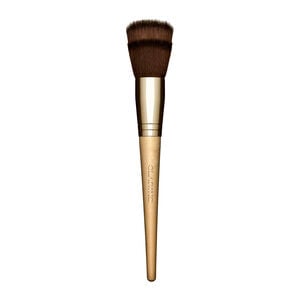
The texture of make-up also influences which applicator feels right. Soft synthetic bristles spread a fluid base easily, while a dense brush deposits more colour in one area and works well with thicker cream textures. The rounded side of a soft make-up sponge suits broad areas such as the cheeks, and a tapered end fits beside the nostrils or at the inner corners of the eyes. Used slightly damp, a sponge can leave a thinner veil of foundation than a dense brush, which is useful when the aim is to soften the edges of concealer rather than build coverage. For setting powder, a loose-bristled brush gives a light dusting, while a compact puff presses powder against the skin where make-up is liable to shift. A short brush handle fits neatly into a small make-up bag, and a broader handle may feel steadier in the hand. Closed lids help keep creams and liquids from drying out, while a secure compact protects pressed powder from knocks in a bag. Brushes and sponges benefit from gentle washing and should be fully dry before they go back into a pouch. A powder brush used for cream foundation, for instance, can pick up powder unevenly if cream is still on the bristles. For someone who likes a pared-back make-up bag, a versatile base may be more appealing than several formulas with overlapping effects. A light foundation and separate concealer offer more flexibility for those who like to vary the coverage across the face. A soft brush makes a useful gift when the recipient’s foundation shade is unknown; a sheer finishing powder is another possibility if its finish and tint suit the make-up they already wear. Explore the Make-up For Flawless Look collection.
